Automatic Tranny Considerations:
| Mating a Subaru engine to an
automatic tranny has its own unique items to consider. You should have
received an extra page of instructions with your KEP adapter and flex
plate. Howver, a few pictures may be helpful with this one.
Bell Housing Hole: The first challenge is to drill out the upper - driver side threaded hole so the KEP stud can pass through. Here is a picture of the hole in question:
|
||

|
||
| Kind of dirty but this is
where you start. Carefully lift out the torque converter - being careful
to NOT remove the splined shaft that goes into the A/T to drive the
hydraulic pump. Then carefully wrap the opening and shafts so that no dirt
gets in.
The next part of the game is to achieve two things- a) Make a hole in the bell housing casting so you can put a nut on the KEP stud that will eventually pass through the hole described below. b) Drill out the existing threads and make a hole all the way through. In the end it should look something like this:
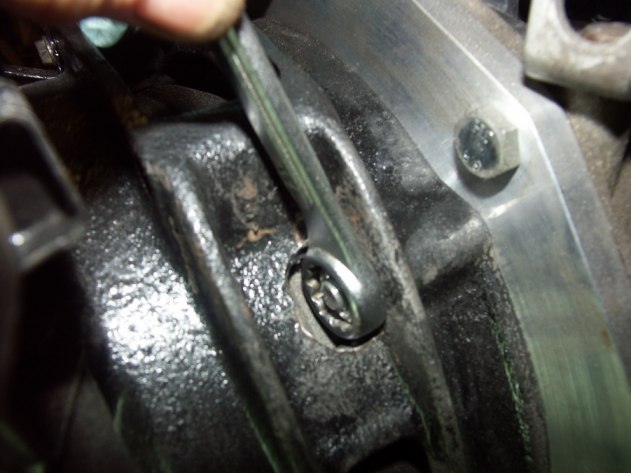
Making this hole requires slow patient action - my technique is to first scribe the centre line of the eventual stud hole on the web of the bell housing casting - then at 90 degrees to that line scribe a line about 3/8ths of an inch from the circular ring where the nut is going to rest. On this line centre punch two spots 5/16ths on either side of the stud hole centre line. Then starting with a small drill make two holes where you centre punched. Then use larger drills to open these two holes up to 9/16ths or 5/8ths inch. This kind of defines the outer edges of the hole and now the fun begins. Using either a hand file or a Dremel tool cut out the web between the holes and make the hole nice and flush with the ring in the casting. Two things to remember: 1) Make the hole just big enough to get a ring type wrench on the 17 mm nut. 2) keep all corners of the hole round with no sharp notches (this helps prevent stress risers that could lead to cracking of the bell housing) Here is a picture of the wrench on the nut:
Once you have the hole in the casting - you can drill the threads out and make the hole go right through the ring in the casting. This wants to be a clearance hole the same as the bottom two stud holes. |
||
| Torque
Converter - Hub Interface:
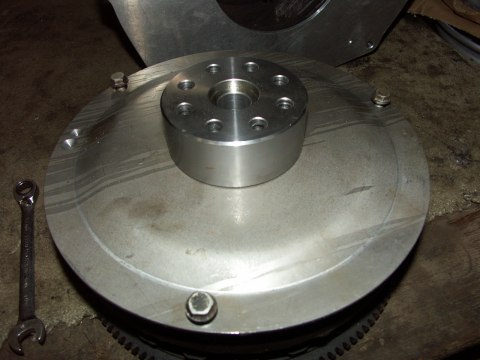
The next important step is to clean up the boss on the torque converter so it fits easily into the KEP crank shaft hub. I have seen these so corroded that the boss would not fit into the hub (refer to picture 1 above). If you do not clean this up the flex plate can be forced to mate up with the torque converter by tightening the bolts and bending the flex plate - I am of the opinion that this is what gives rise to flex plate cracking but I may be wrong. Here is what I do before installing the hub and flex plate: Apply a bit of grease to the boss on the torque converter so it slides in easily. Then just check to be sure the flex plate is going to fit properly:
It should fit so the three bolts can be done up and the hub is fitting tight up to the flex plate. Now you are ready to install the flex plate and hub on the Subaru crank shaft per KEP's torquing instructions. |
||
| Starter
Bolt/Stud:
Another area of concern that is common to both manual and automatic trannys is the bolt that goes through the starter. KEP supply a long stud that can be used - but if you are using a stock vanagon starter (86 and up) the nut can not be turned because the casting was designed to hold the nut while you turned the bolt from the other end. What we use is the long hex head VW starter bolt rather than the KEP stud and use a spacer that came from the donor Subaru to take up the extra length of the bolt - as shown here:
|
||
|
|
||
| Air Cooler
for Tranny:
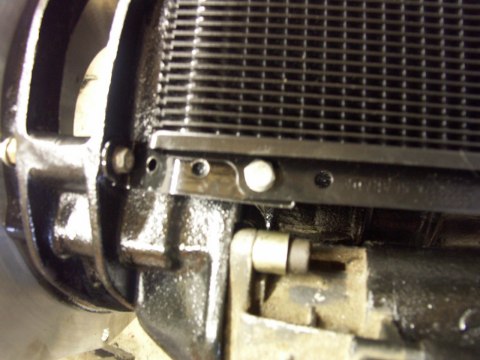
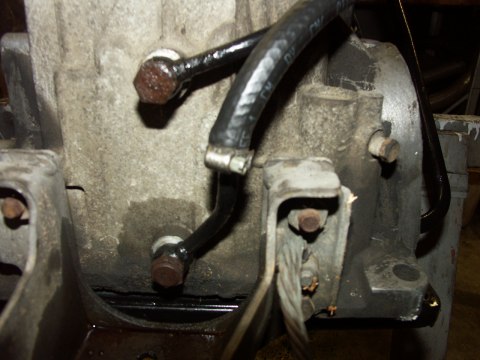
To avoid any risk of mixing coolant and tranny fluid some people will want to replace the coolant oil cooler with an air cooler - this becomes much more important if you plan to change the shifting point on the tranny governor. The cooler depends on the fan action of the torque converter to move air through it. The next few pictures show the mounting of a B&M air cooler:
The banjo fittings came from a U-pic wrecking yard - off a Golf or Jetta fuel injection system. Fittings off a number of European fuel systems will fit - just keep you eves open when you visit your favourite wrecking yard.
|
||
| Throttle
Linkage:
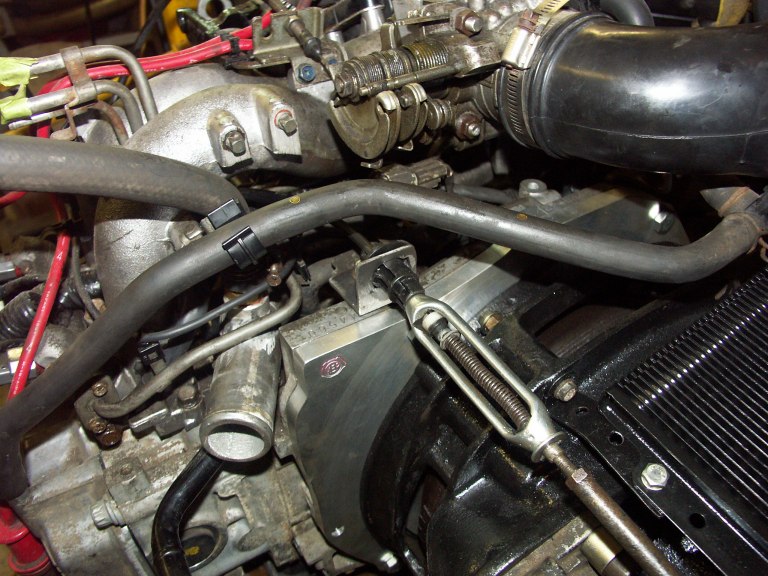
There are a few ways to go here. Small Car sell a very nice throttle linkage kit that people have used very successfully. In my case I fabricated my own - so that I could duplicate the VW over travel arrangement that existed on the old WBS throttle. Here is what I came up with:
It uses the stock Subaru throttle cable and a shortened VW throttle linkage rod. I just cut the end off the rod and rethreaded the tube to take the original adjusting rod. The assembly looks like this: It allows the vanagon accelerator pedal to supply full throttle to the Subaru engine and then the over -travel provides the tranny shift down action.
|
||
| Ready to
Install:
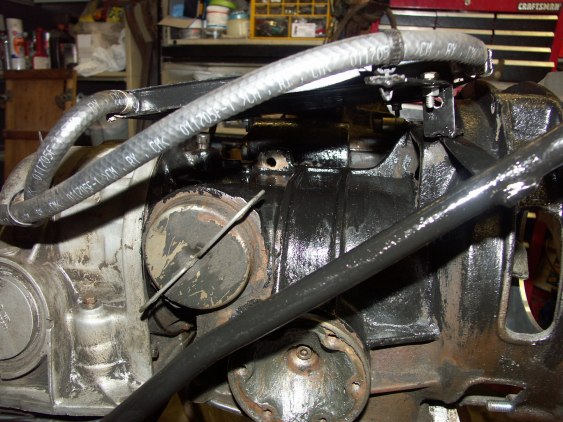
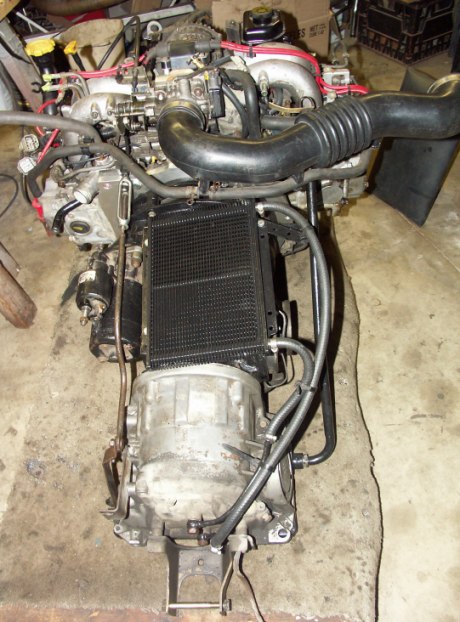
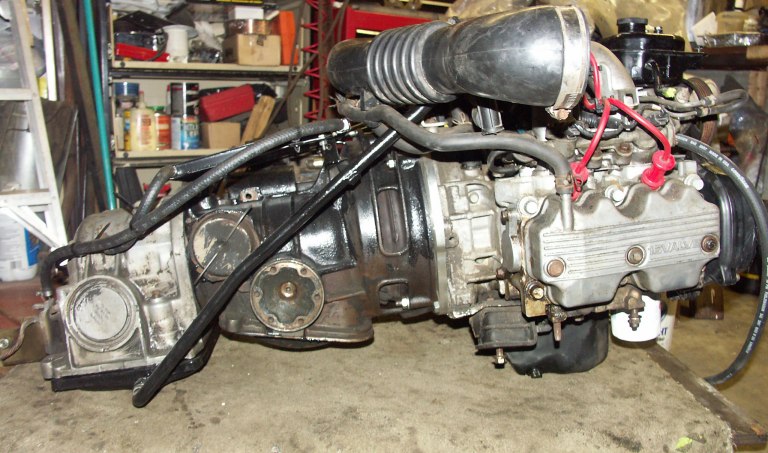
When you are ready to bolt up the tranny and engine - it is always worth while replacing the oil seal where the torque converter goes. Be careful installing this seal as it is very soft and can be damaged easily. When you install the new seal drive it in until flush but NO further. If you drive it in too far - you may end up with a significant leak due to the fact the seal does not contact the shoulder of the torque converter when the flex plate bolts are tightened up. When it is all done it should look something like this:
The dolly the engine assembly is resting on will roll easily under the vanagon for easy lifting into place. Much easier to do the complete assembly rather than try to match the tranny to the engine when it is in the vanagon.
Please let me know if you see something I have either missed or screwed up Tom |
||


  |
||
 | ||
|
| ||
|
| ||
|
| ||
|
|